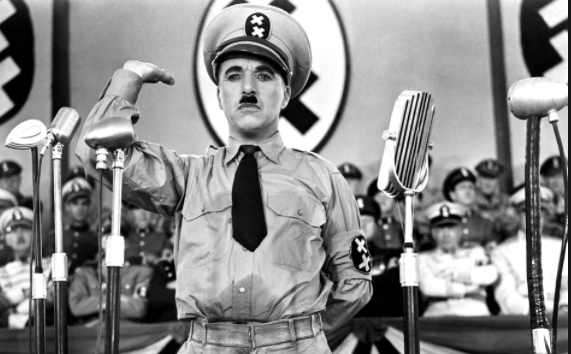
How effective do you think Charlie Chaplin was with his creative challenge to the war?
Charlie Chaplin (1889-1977) broke both societal and cinematic boundaries with his creative take on the war within his film The Great Dictator. Set on the circumference of WWII, the film showcases Chaplin as a satirical version of Adolf Hitler who, in the movie is characterised as Adenoid Hynkel. Through the representation of Hitler in such a light during his reign, Chaplin innovatively challenges notions of war and human destructivity, highlighting that war is in fact, a ridiculous outcome of the wrong people in power.
Within the film, Chaplin utilises a clown-like form of acting to Lampoon Hitler and therefore provide a direct critique of war and the destructive nature of human beings. This can be recognised within a scene in the film in which a cannon is being loaded with a missile on target to destroy the Notre Dame. As the missile is set to fire, it falls out of the cannon and rolls away in a comedic way, indicating the fail of the launch. This can be seen as a metaphor for the degressive nature of war and further illuminates Hilters flawed morals. Moreover, as the dysfunctional missile lays on the ground, Hynkel is sent to check its fuses. As he approaches the missile it spins as if following his moves. This frightens Hynkel, causing him to run around in circles to dodge the missile. Through this scene, it can be speculated that Chaplin is critiquing the way in which this war was a product of this corrupt leader and that when faced with the possibility of being hit by the missile himself, he is scared. Therefore, directly emphasising upon Hitlers selfishness and hypocrisy. As a result, it can henceforth be argued that Chaplin’s comedic approach effectively challenges the idea of war.
In contrast to this, the Dictator’s speech provides yet another creative layer to the film that works to challenge the notion of war. At the end of the film, Chaplin as Hynkel gives a moving speech on the catastrophes of war. Chaplin utilises emotive speech and hand gestures along with an accompanying score to create a powerful cinematic moment. However, the beauty behind this scene lays within its ability to produce a sense of irony as this speech on peace is being given by the creator of the war himself, Hiter. As Chaplin places moments of comedy and ends with this serious scene, he is able to effectively critique the war as ridiculous yet also advocate for its end.
Thus, through moments of comedy layered with serious tones, Chaplin’s film creatively challenges the idea of war and the destruction that humans bring to one another greatly.
Film referenced: The Great Dictator.
Photo taken from: Google Images
 The Best of Literature