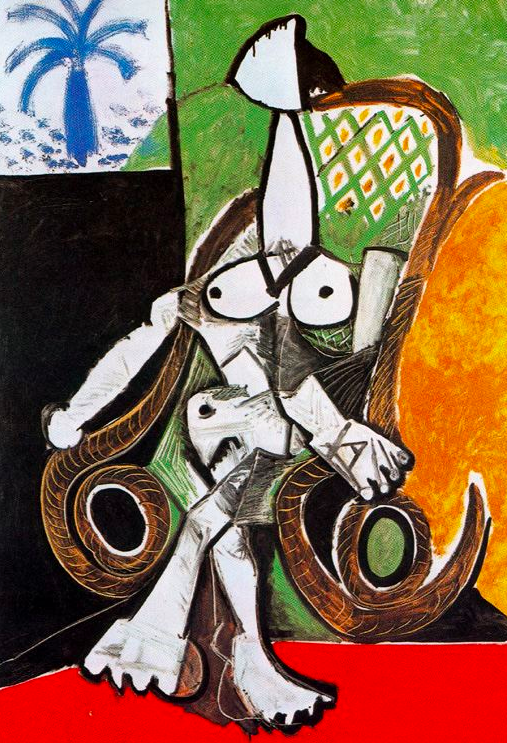
Describe the Picasso painting above. In other words paint his picture IN WORDS. Say briefly what makes it “modernist”.
Pablo Picassos’s painting “Femme nue au fauteuil à bascule “. Like many of Picassos pieces, my eyes don’t know where to look first. The colours, the distorted shapes, textures and random images burst from the canvas. Gazing at it is like a child going to the carnival for the very first time; overwhelming yet spectacular. Primarily, it may seem incomprehensible. One could almost say it’s like a cake. A bountiful of flavour-some ingredients mixed together that at first appear to be a gooey, sometimes grainy, sloppy puddle. However, eventually with time and cooking it becomes a sweet cake. Just as in time, Picassos ‘ingredients’ have created the perfect testament to the modernist period, the perfect ‘cake’.
The colouring is the first ingredient that can be drawn from the painting. The harsh contrast of the black aside the bright tones of the orange, green and blue against the white creates a vibrant backdrop and sets our eyes towards the figure. A blue palm tree sits in the left-hand corner of the piece, appearing isolated from the rest of the painting. Around the white figure are two swirling brown shapes that look almost like a snake; all while sitting atop a bright red floor. Although the use of these colours seem obscure, Picassos particular choice of such invigorating tones alludes’ to a time of great change and experimentation. One in which strays from tradition and aims to shock viewers in order to receive a response; a typically modernist concept.
As you peer your eyes more deeply into the image, various shapes form and textures come alight. The title translates to ‘woman naked in armchair to the scale’, however at first one might not see this as they are distracted by the colours and its peculiar shapes. While delving deeper into it, one can make out the brown swirls to be the head of an armchair and the white to be a figure of a woman. The textures of the piece also aid in identifying these aspects of the painting as the armchair is carved with fine lines indicating a decorative piece and the woman is etched with smeared black paint, highlighting the figure. As well as this, the colours of the backdrop not only vary in colour but also grain, illuminating the distorted presentation of the woman. It is evident that all ‘ingredients’ of the painting are fragmented and collaged. The body parts of the woman are not in order, the colours and textures are confronting and the armchair is created in an odd shape. Looking at the way in which these elements have been crafted on the page gives insight into the modernist period. The fragmentation and sense of disorder it conveys is suggestive of the declining state of society (which makes sense being created on the cusp of war). As the woman is painted with faded black ink and her body doesn’t align, she represents human destruction. Moreover, the armchair can see be analysed as a symbolic notion, highlighting negative materialistic ideologies.
All in all, as one analyses these elements or ‘ingredients’ it is evident that Picassos painting becomes the perfect cake or more specifically, the pinnacle of modernist ideology.
Image taken from: Micheal Griffith’s WordPress site
 The Best of Literature
I love the “cake” image you have used to capture the essence of Picasso’s painting. I think he would have loved this creative transformation of his ugly lady into a CAKE! Well done…. and it is yours!!!
*Please attend to editing your work carefully. Here is what I have picked up:
*Alike many of Picassos pieces,= Like many of Picasso’s pieces, [‘s or s’ – Apostrophe- if there is a meaning of ownership ( the boy’s apple/ the boys’ apples) then you need an apostrophe. See http://owl.english.purdue.edu/owl/resource/621/01/. But don’t use apostrophe s for normal plurals!!!
LikeLike
Hi Teneille,
I really loved your blog this week! I was immediately intrigued to see how you were going to explore Picasso’s painting and you do this brilliantly through the ongoing metaphor of cake. I especially like how you refer to the colours, textures, and details of the painting as ‘ingredients’ and how it takes time for them to become a cake after being mixed together, just like Picasso’s painting that at first glance can be overwhelming, but when you look closely you can see the image start to form. My only piece of feedback is to watch your grammar and word choices in some parts of the blog. For example, the wording choice of ‘bountiful’ in “a bountiful of flavour-some ingredients” does not make for a very cohesive sentence. Nonetheless, the overall idea and symbolism behind the blog was great and I really enjoyed reading it 🙂
LikeLike