Blog Feed

Australian Literature peer review 4

Blog by: Bruno Filletti. https://brunosliteratureblog.wordpress.com/2019/09/02/art-gallery-of-new-south-wales/

Hi Bruno, I really enjoyed this blog entry! I firstly enjoyed the way you verbally captured “Milford Sound, New Zealand” by Eugene von Guérard. I like your choice of wording in this paragraph to describe the greatness and majestic quality of the painting. When gazing upon this painting I would have to agree – you are struck with a sense of romanticism and beauty. I like how you have directly contrast this sense of beauty that interested you about the painting with the challenging Captain Cook sculpture. I found the way in which you were able to juxtapose the beauty found in the painting with the sombre tone of the sculpture particularly appealing. I also think it was great to see you mention the way the sculpture challenges typically ‘mighty’ views of Captain Cook, giving you good link to the question. I think perhaps to strengthen this link you could potentially give more historical insight into Captain Cook himself. Perhaps also you could fine tune your blog and check over for any grammatical errors to make it stand out that little bit more. Other than I thought it was really interesting myself to see what artworks you were interested in and also challenged you. Keep up the good work!

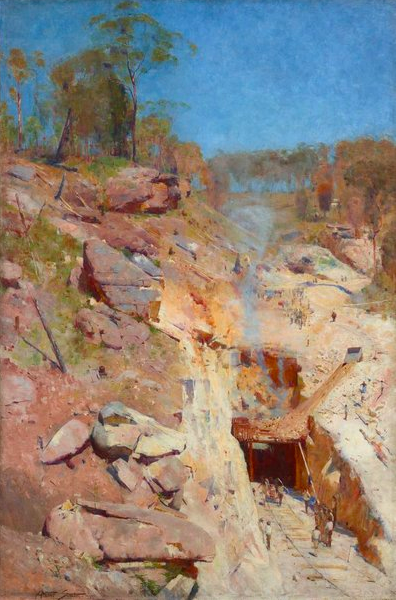
“Fire on Lapstone Tunnel”

How does Anthony street’s “Fire’s on Lapstone Tunnel“ visually reflect ideas explored throughout the unit ‘Australian Literature’ ?

Hanging upon the walls of the National Art Gallery of New South Wales sits the “Fires on Lapstone Tunnel” by Anthony Street. Despite the arrange of Australian pieces that hung beside this painting, I personally feel as if this particular painting by Street has visually cemented my understanding of the themes explored through the unit Australian Literature. I believe in this painting, Street highlights the power of the Australian landscape and the destruction of colonisation on the spiritual, cultural and historical aspects of Australia in which are key ideologies that we have explored throughout the unit. Depicted in the painting is the very first tunnel being created in the Blue Mountains. The art work is split into two sections; to the right hand-side are people small in size building the tunnel while to the left is the natural elements of rock and bush. The left-hand side of the painting is dominate to that of the right-hand side, demonstrating the power of the bush over the colonisers. Moreover, the people in the painting appear inferior to the natural elements and injured due to tumbling rocks. In painting, as the nature appears superior and even dangerous to the colonisers, Street comments on the power as well as catastrophic destruction of the land in which once had historical, cultural and spiritual qualities to Indigenous people, the traditional custodians of the land. The destruction of the land and therefore these qualities were further explored throughout the unit within Lisa Bellear’s poem ‘Urbanised Reebocks’. In her piece, Bellear illuminates the spiritual, historical and cultural corrosion of the traditional way of life for Indigenous Australians due to materialistic obsessions, however, emphasises the importance of the land in healing this sense of destruction. This is evident as Bellear states: “uncloaked feet hit the earth…and it’s ok to cry” (Urbanised Reebocks). It is evident that as the protagonist removes her shoes (and therefore strips herself of materialised creations) she comes in contact with the land in which has a profound effect on her. This contact with the land allows the protagonist to remember the power of nature as opposed to man-made items and reflect upon the destruction of spirituality as well as culture, hence aligning with the Street’s painting. Thus, it can be noted that a key theme taken from the unit Australian Literature is the power of land and the destruction of spiritual, cultural as well historical qualities associated with Australia. It was not until gazing upon Street’s painting that I really connected with these ideologies and pieces of writing explored in class such as Bellear’s poem. The art work provoked me to consider whether or not modern-day Australia appreciates the power of the land and acknowledges the destructions that were forced upon it and the traditional custodians of the land. Perhaps, we are on the right track but perhaps, we also still have a long way to go.

Feature image: “Fire on Lapstone Tunnel” by Anthony Street taken from the National Art Gallery of New South Wales’ website: https://www.artgallery.nsw.gov.au/collection/works/832/

America Writing Peer Review 4

Blog by: Brandon Ng. https://newyorker.home.blog/2019/09/06/a-bird-came-down-the-walk/

Hi Brandon! I really enjoyed this poem. The simplicity of your poem is what struck me the most. I can picture the simple and slight movements of the bird itself and the innocence that lay within in. I think you have captured perfectly a minimalist style with the simple movements of the bird. Through the use of rhyme as well, the peaceful tone of the poem is evident. I believe to strengthen your blog you could perhaps make it a bit longer to give it some more depth. As well as this, Perhaps the use of a visual aid could really make this poem pop! Other than that, I think your choice of wording and peaceful concept made it such an easy and enjoyable piece to engage with. Keep up the good work!

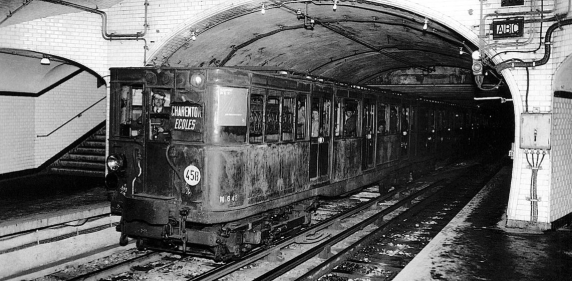
Ezra Pounds “In a Station of the Metro”

Select the one modernist poem or text that you found spoke to you most directly. Quote the text and tell us how the text moved you.

During our exploration into modernism, we delved into poetry by the modernist poet, Ezra Pound. In particularly we focused on his poem, “In a station of the metro” in which out of all pieces we read throughout this topic, resonated with me most. The poem itself only consists of two lines but the modern minimalistic style is what I believe amplifies it’s meaning the most. The poem reads as:

“The apparition of these faces in the crowd;

Petals on a wet, black bough.”

Despite being rather short, the stark contrasts and visual imagery that the poem is able to produce astounds me. This contrast is evident through pounds particular use of “apparition” to describe the faces, juxtaposing the poignant and colourful imagery of “petals on a wet, black bough” (In a station of the metro). Through choosing to describe the people as ‘ghost-like’ within the bustling crowd of a metro, Pound comments on the negative impact of man-made industrialisations on humanity. Pound further cements this negative ideology of the impact of man-made items on humans as he compares the faces to wet petals on a black branch. When I first read this line immediately my mind was infiltrated with the visualisation of flowers sticking to a tree; their colour illuminated against the black back drop. This image aligns with that of ‘the ghost-like’ faces in the black darkness of a metro as humans ‘stick’ to that of their own industrialised creations. Furthermore, by creating this image and contrasting it with scenes of the natural environment, Pound identifies the cyclical nature of humanity, much alike petals growing on a tree. In creating this image, I believe pound comments on the way in which humans float through life obliviously amongst one another, focusing only on the future industrialised society as opposed to the natural world.

Pounds ability to capture such rich meaning in only two lines in what thus, moves me the most about this poem. He is able to articulate the cyclical nature of human beings through a technologically developing world, commenting on their lack of focus for the natural world in only a space of two lines. Everything down to Pound’s grammar and tight knit choice of wording aided in producing the significant meaning of this poem, highlighting the power of words themselves in which what truly moves me most.

Feature Image: Metro taken from google images https://www.google.com/search?biw=1440&bih=789&tbm=isch&sxsrf=ACYBGNSJf-gUuHCTEnfbtxBbsl9FIfojSQ%3A1571204545902&sa=1&ei=wa2mXbzZNqqCrtoPi-OO6A0&q=+1913+metro&oq=+1913+metro&gs_l=img.3..35i39.5202.5421..6136…0.0..0.305.563.2-1j1……0….1..gws-wiz-img.21qqccysOKE&ved=0ahUKEwj8vc-GiaDlAhUqgUsFHYuxA90Q4dUDCAc&uact=5#imgrc=Jqd_cj6iGhd8YM:
America Writing Peer Review 3

Blog by: Nancy David. https://nancysliteratureblog.home.blog/2019/09/15/blog-3-a-letter-to-james-baldwin/

Hi Nancy! I really enjoyed this blog entry. To me, this seemed like a true professional and well written letter. I really enjoyed how you incorporated more than one of Baldwins texts to support the way in which he widely demonstrates the severity of racism and discrimination. I can see through this letter how much his works have impacted your understanding of these issues and the power of Baldwins writings; I also feel the same way! I particularly like how you wrote “There is power, conviction and logic in your writing, which portrays a sense of realism, suffering and describes the discriminations experienced by the African American communities”. This blog truly encapsulates the sense of logic and realism through your choice of wording in which is also seen in baldwins works. I think perhaps by incorporating some textual evidence from the writings you have referenced could strengthen you blog even more so! Other than that, I really enjoyed this, keep up the good work!

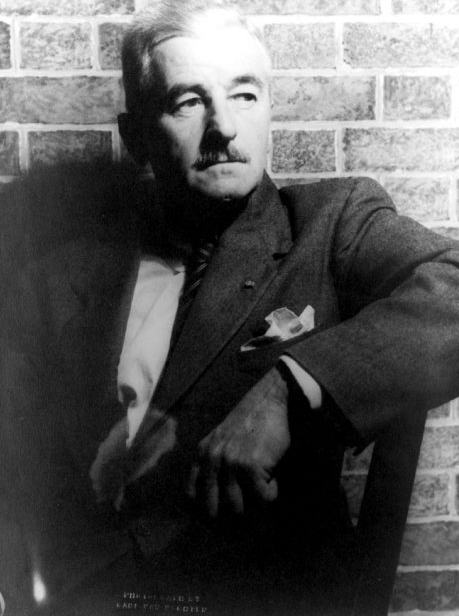
William Faulkner’s Nobel Prize Speech

How do you understand Faulkner’s extraordinary statement in his Nobel Prize speech “the problems of the human heart in conflict with itself … alone can make good writing because only that is worth writing about, worth the agony and the sweat” ?

To me, Faulkner’s statement emphasises the fact that great pieces of writing are a product of one’s intrinsic selves and deep emotions embedded within. He articulates that the ‘human heart’ is in battle with itself. In the context of Faulkner’s time, that being post World War II, I believe that this battle within the heart is the constant shift between ‘agony’ and compassion. People during the time of this speech were caught between a world of lingering death and rising above these tragedies. They wrote from of a place of sheer fear and emotional turmoil due to the catastrophes in front of them. It is these experiences that have created a shift in perspective in the way in which people see the world. Faulkner highlights in his speech that this turmoil and experience create the basis of powerful writing. However, although this can be true as our emotions allow us to delve deeper into our conscious and produce something that is meaningful, he continues to argue in his noble prize speech that this emotional turmoil should not always be the basis of writings as it forces one to “write[s] not of love but of lust…without pity or compassion” (William Faulkner, Nobel Prize speech). I believe that Faulkner expresses that although the agony and sweat of these experiences are worth the powerful pieces of literature they provide, I believe that he further aims to resonate that real great literature lays within one’s ability to realise that the perseverance of this agony and sweat can lead to more than writings of conflict– it can lead to writings of hope if we allow it to do so.

Feature image: William Faulkner taken from google images https://www.google.com/search?biw=1440&bih=789&tbm=isch&sxsrf=ACYBGNSiM3B0IJ3187E7lPy2wBNDl7SCwQ%3A1571204560335&sa=1&ei=0K2mXb6LFNf-rQG65JmADg&q=william+faulkner&oq=william+faulkner&gs_l=img.3..0l10.171629.177330..177447…2.0..0.1312.9834.3-7j1j4j0j4……0….1..gws-wiz-img…..10..35i362i39j0i131j0i67j0i10i24.zE7HmGBEeEY&ved=0ahUKEwi-s8CNiaDlAhVXfysKHTpyBuAQ4dUDCAc&uact=5#imgrc=v8Jx1HVHrPAWoM:

Australian Literature Peer Review 3

Blog by: Lauren Perry. https://australianliteratureblogbylaurenperry.home.blog/2019/09/15/blog-4/

Hi Lauren, I really like how positive you have made this blog! This letter appears very easy to read and well punctuated, it felt like reading a real letter that had been sent to Meg as it flows. I have to agree with your stance, that being that Meg should go for whatever/whoever it may be that makes her happy. I also really like how you incorporated Aunt Daise into the letter I though that was very sweet. This blog led me to think about what it may be that Patrick White might think of your letter. I think he would love that you have encapsulated that sense of ‘mystery’ and ‘poetry’ that is stemmed from Megs and Lummy’s relationship. I think perhaps if you had made this letter a little longer and had some more in depth detail perhaps about Meg, Lummy or Myrtle, it would of strengthened your blog. Otherwise, I really like this entry. Keep up the good work!

“Down at the Dump”

Chose any one of the Patrick White texts mentioned above and say how you think it illustrates what White was saying in his essay “The Prodigal Son”.

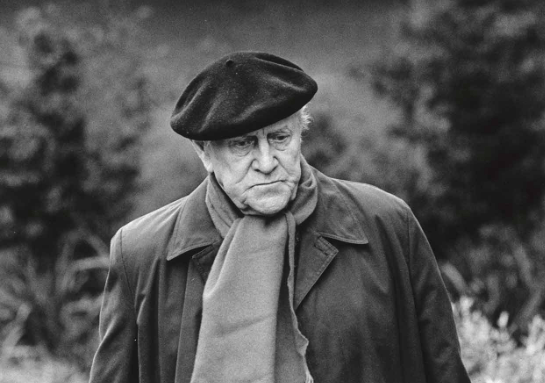
In Patrick White’s essay ‘the Prodigal Son’, White subtly critiques the cyclical and ‘ordinary’ nature of Australian suburbia. However, although acknowledging this sense of ‘ordinary’ that prevailed the streets of Australia, it is also exactly what inspired White to remain here. White took this opportunity of staying in Australia to explore this Australian mundanity and in turn, demonstrate through his writing how ‘poetry’ and  ‘mystery’ can be found beneath the seemingly simple lives of Australians and overrule shallow, materialistic desires. I believe this ideology can be noticed in White’s short story ‘Down at the Dump’ through the juxtaposing characters Myrtle and Meg. In the short story, White expresses Megs deep sadness due to the loss of her Aunt Daise, however on the contrary Myrtle (Megs Mother), does not appear sadden by her sister’s death as she is more so concerned with the way people portray her and her family. This is evident as she states: “Meg?…Did you polish your shoes?”, highlighting Myrtles lack of empathy in the situation as she cares more so of the family’s aesthetic appearance at the funeral than her sisters death. Moreover, this materialistic trait contrasts the ‘poetry’ and ‘mystery’ found within the relationship between Meg and her Aunt, allowing readers to embrace the poetic normality of the relationship and question the materialism of Myrtle. This is evident whilst Meg and Daise are picking flowers as White states: “Meg loved the idea of it, she loved Daise”. Hence, through creating these contrasted characters White allows one to consider the extraordinary emotions that can derive from ordinary relationships and the impact that this can have on one (such as meg). By doing so, he further allows one to question the notion of materialism and think about how materialistic desires can blur one’s sight of the things happening in the world around them.

Feature image: Patrick White taken from google images https://www.google.com/search?biw=1050&bih=585&tbm=isch&sxsrf=ACYBGNQ45Z5vLwsx4J9Fglve55HQ6Bzqdg%3A1571201819864&sa=1&ei=G6OmXYClNIWv9QOxioWgCg&q=patrick+white+&oq=patrick+white+&gs_l=img.3..0l10.2102868.2106316..2106638…1.0..0.699.5305.0j3j0j7j1j3……0….1..gws-wiz-img…..9..35i362i39j0i131j0i67.mW-yXfPhRLs&ved=0ahUKEwjAnt_y_p_lAhWFV30KHTFFAaQQ4dUDCAc&uact=5#imgrc=zT0F9bR7YUkc-M:

America Writing Peer Review 2

Blog by: Maria Lo Campo. https://marialocampo.wordpress.com/2019/09/10/american-literature-blog-2/

Hi Maria, I think you have written a great blog here! I particularly like the way in which you gave some context into Whitman’s work regarding his admiration for Abraham Lincoln. This clearly pointed out to me why it is that Whitman saw Lincoln as a ‘captain’. I really like how you have drawn out certain quotes and bolden them to further to prove your point. I have to agree with you and say that I do really think that repetitive nature of the quote ‘O’Captain my Captain’ accentuates his admiration for him as president. I think perhaps to strengthen your response you could by place in literary techniques to back your quotes and further elaborate upon them. Besides from that, I think that your blog was clear and got to the point as to why you think Whitman feels so highly of Abraham Lincoln! Keep up the good work!

Du Bois and the ‘color-line’

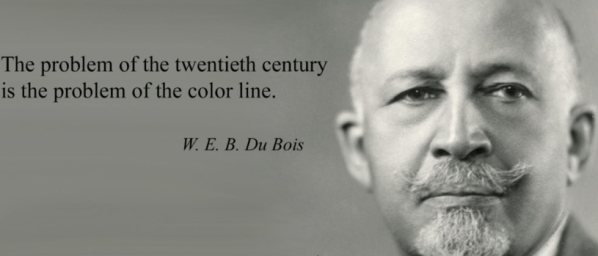
DU BOIS “The problem of the Twentieth Century is the problem of the color-line”. What do you think Du Bois means?

I believe that when Du Bois stated: “The problem of the Twentieth Century is the problem of the colour-line”, he simply and accurately articulated the ideology that the problem of the twentieth century lays within the disunity between races. For me, the statement gives me distinct imagery of a physical line and on opposing sides of that there are two different races; European and African Americans or more bluntly; white and black skin tones. Du Bois highlights that consequently due to this line, African Americans are still targets of discrimination. Moreover, the knowledge I have gained from the unit American writing has allowed me to comprehend and put into perspective why this line and therefore discrimination may exist and still does exist to this day. I have come to the conclusion that the colour-line derives from the social and political inequalities amongst the races. This stems from slavery and white supremacy. However, although these inequalities have been fought against, there is still a profound discrimination residing. This therefore allowed me to question why it may be that even after clear preaching of African Americans for equality, there is still racism. Could this be because it is in human nature for there to be continuous conflict? I Believe that when Du Bois stated this quote, he posed this exact question, urging readers to consider one’s own moral compass and question the way in which we allow history to define our present. As Du Bois resonates these questions, I cannot help but to think of when the ‘line’ itself may break and how this would occur. It is thoughts like this and ideologies stemmed from the idea of the ‘colour-line’ that are needed to move forward in society, hence making Du Bois and his writings a pivotal part of the world.

Feature image: W.E.B DuBois with his famous quote taken from google images https://www.google.com/search?q=du+bois+and+the+colour+line&sxsrf=ACYBGNQbP-zis-BSVzgiAzKWxYm0e5JzNA:1571205166762&source=lnms&tbm=isch&sa=X&ved=0ahUKEwjF7tWui6DlAhUMfysKHeu_AL8Q_AUIEigB&biw=1440&bih=789

Blog at WordPress.com.

Up ↑

Design a site like this with WordPress.com
Get started