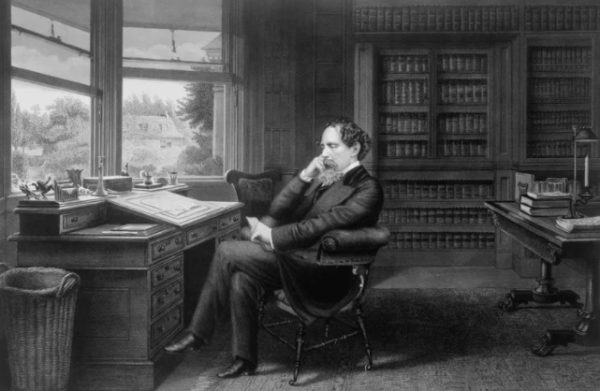
A letter to Dickens

Write a letter to Charles Dickens commending him on how he has exposed real deficiencies in human behaviour.

Dear Mr. Dickens,

I am writing to commend you on your ability to expose real deficiencies in human behaviour, particularly throughout your endearing novel ‘Hard Times’. The way you have encapsulated and so poetically expressed the extreme negativity that prevailed during the Victorian era as a result of industrialisation astounds me. I am especially intrigued with your ability to capture how these technological advancements forced humans into a utilitarian mind-set, placing their focus towards “fact, fact and fact!” (Dickens 10) as oppose too engaging with the subconscious mind and human emotion. I specifically love how you achieve this through exploiting the corrupt educational system of the Victorian era as children were taught to neglect their own sense of creativity and internal wisdom to submit to a confined, ‘factual’ and ‘practical’ society. This ideology was illuminated immediately for me in your novel in chapter two when Cecilia was asked to define a horse and if she would carpet her future home with prints of flowers. While asked to define the horse, Cecilia was unable to so to the standard of Mr Gradgrind as she could not identify the factual elements of a horse such as the number of its teeth (Dickens 7). This to me, was a brilliant way to critique the way in which children were taught from a young age to only concentrate on the empirical evidence that drives the world. Furthermore, alongside this moment, I admire how you cleverly analyse the way in which this fact-based mentality forced children to abandon their sense of creativity and free-will. This is evident in the moment where Cecilia states: “They [the flowers] would be the pictures of what was very pretty and pleasant, and I would fancy –“(Dickens 10), to which she is abruptly interrupted with “ay! But you mustn’t fancy!” (Dickens 10). You make it extremely clear that Cecilia must suppress her ‘wondering’ mind and stick to the ‘facts’ within society, thus you critique the way in which human beings failed to nurture the minds of one another which ultimately led to an impoverished society (Dickens 59). The way you have been able to make such commentary on these things inspires me. You have written an avenue for change and shed light on the very failings of human beings that one must not take lightly. I thank you for your incredible contribution to the world.

Kind Regards,

Teneille.

Texts quoted:

Dickens, Charles. Hard Times. Proofed by David Price. 1854.
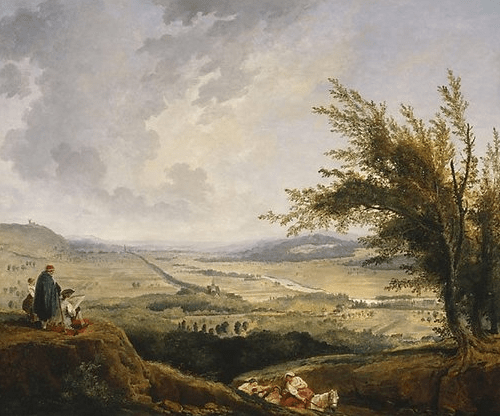
Image take from: https://www.google.com/search?q=victorian+era+charkes+dickens+&tbm=isch&ved=2ahUKEwjV2pnL04jpAhUSFysKHR0ZAQwQ2-cCegQIABAA&oq=victorian+era+charkes+dickens+&gs_lcp=CgNpbWcQAzoECAAQQzoCCAA6BggAEAgQHlCuT1jYY2C2ZWgAcAB4AIABzAKIAasgkgEIMC4xLjEyLjOYAQCgAQGqAQtnd3Mtd2l6LWltZw&sclient=img&ei=KtamXtWdEJKurAGdsoRg&bih=544&biw=1050#imgrc=-UxJ6ev_JyV9fM

“An Extensive Landscape Near Paris”

Which painting made the strongest impression on you and how did it amplify your understanding of any of the literary themes that we have been exploring.

Amongst our exploration into art pieces created in the Romantic Period, we came across a painting by Hubert Robert titled “An extensive Landscape Near Paris”. This piece by far had the strongest impression on me as it solidified my understanding of literary themes associated with this time.

Immediately looking at the painting a sense of peace and tranquillity is evoked as you are catapulted into the sublimity of nature. This is achieved through the vast green and yellow landscape accompanied by an ascending hillside that sits directly in front of viewers eyes. In the right frame of the painting, a tree stands twisting and distorting upon the hillside, appearing superior to the small people. Moreover, the mix of purple, white and grey hues in the sky create an almost dreamlike atmosphere. When all of these elements are viewed as a whole the great beauty that is contained within nature is elucidated. This therefore directly amplifies my understanding of literary themes associated with the Romantic Period as one of the key aspects for this time was the appreciation and sublimity of nature as opposed to materialistic ideologies that were favoured in the enlightenment period. In addition to contrasting these materialistic ideologies, the inclusion of the women dressed in what can be assumed as lower class clothing moving upwards through the hillside metaphorically implies the progression of those in lower class positions and the beauty found within the ordinary.

 Furthermore, this theme of the appreciation of nature is further highlighted through the painter’s intentional incorporation of the people on the hill painting the beauty that lays ahead of them. This directly relates to literary themes that we have been exploring as it highlights the way in which Romantic idealists valued what they can gain from nature as opposed to intellectuality gained in books.

Thus, from this painting I have gained a profound understanding to the themes associated with the Romantic Period which include; one’s appreciation of the beauty of nature, the progression of the lower class and the way in which nature can unlock wisdom in a way that intellectual knowledge simply cannot.

Image retrieved from: https://www.artgallery.nsw.gov.au/collection/works/177.1995/

Blog at WordPress.com.

Up ↑

Design a site like this with WordPress.com
Get started