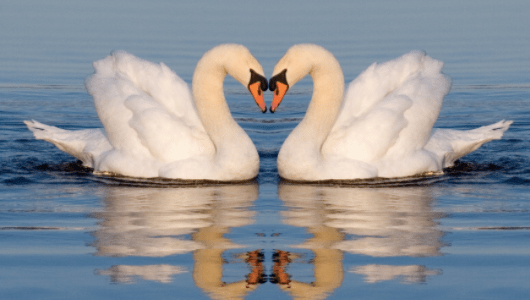
The Wild Swans at Coole Park

Do any of Yeats’ poems connect with your own personal experience? Select one of Yeats’ poems (or a section thereof) and discuss how the poem connects with your own understanding of the world in which we live.

Yeats’ poem “The Wild Swans at Coole”, for me is one of his most significant pieces as it resonates with my personal understanding of the world in which we live. The poem follows the narrators two contrasting visits to Coole park to watch the swans swim in the pond. On his second trip, the narrator clings to the beauty of the swans in a changing, war-struck world.

In the first stanza of the poem, the narrator highlights the beauty of the natural scene in front of him during his first visit to Coole park. Utilising imagery he states: “Upon the brimming water among the stones are nine-and-fifty swans” (Yeats lines 5-6).  Here Yeats illuminates the beauty that can be found in the world, in particularly through the swans. Yeats further elaborates upon this natural beauty through the use of a metaphor in: “The bell-beat of their wings above my head” (line 17). Here Yeats compares the flapping of the swans’ wings to the sound of a bell, illuminating the rhythmic beauty of the swans. However, the tone of the poem changes as upon Yeats’ second trip to the pond as he exclaims: I have looked upon those brilliant creatures, And now my heart is sore” (line 13-14). Due to the context of the time, his heart is ‘sore’ but the swans remain “mysterious [and] beautiful”, while also still subject to change as is Yeats himself (line 26). Thus, the poem is a testament, cementing the ideal that the world is ever changing and even beauty that can be found is not permanent, suggesting Yeats’s pessimistic attitude due to his surroundings.

This connects with my own understanding of the world as I am constantly bombarded with images of beauty that is overridden by technological advancements. For example, I once had an amazing view of the waterfront from my apartment but overtime this view has been compromised due to a building being constructed right in front of the view. Therefore, demonstrating to me the way in which beauty is not mortal and changes overtime.

Perhaps this is something that we need to start re-evaluating.

Text referenced: The Wild Swans at Coole Park, W.B Yeats
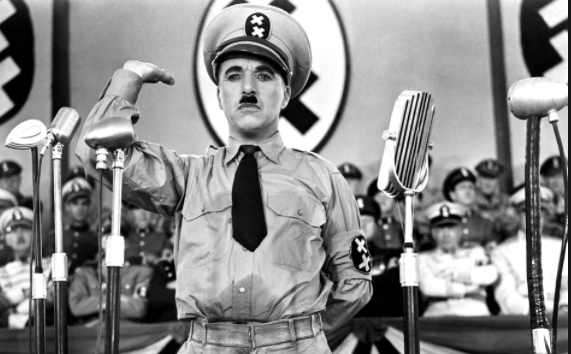
The Great Dictator

How effective do you think Charlie Chaplin was with his creative challenge to the war?

Charlie Chaplin (1889-1977) broke both societal and cinematic boundaries with his creative take on the war within his film The Great Dictator. Set on the circumference of WWII, the film showcases Chaplin as a satirical version of Adolf Hitler who, in the movie is characterised as Adenoid Hynkel. Through the representation of Hitler in such a light during his reign, Chaplin innovatively challenges notions of war and human destructivity, highlighting that war is in fact, a ridiculous outcome of the wrong people in power.

Within the film, Chaplin utilises a clown-like form of acting to Lampoon Hitler and therefore provide a direct critique of war and the destructive nature of human beings. This can be recognised within a scene in the film in which a cannon is being loaded with a missile on target to destroy the Notre Dame. As the missile is set to fire, it falls out of the cannon and rolls away in a comedic way, indicating the fail of the launch. This can be seen as a metaphor for the degressive nature of war and further illuminates Hilters flawed morals. Moreover, as the dysfunctional missile lays on the ground, Hynkel is sent to check its fuses. As he approaches the missile it spins as if following his moves. This frightens Hynkel, causing him to run around in circles to dodge the missile. Through this scene, it can be speculated that Chaplin is critiquing the way in which this war was a product of this corrupt leader and that when faced with the possibility of being hit by the missile himself, he is scared. Therefore, directly emphasising upon Hitlers selfishness and hypocrisy. As a result, it can henceforth be argued that Chaplin’s comedic approach effectively challenges the idea of war.

In contrast to this, the Dictator’s speech provides yet another creative layer to the film that works to challenge the notion of war. At the end of the film, Chaplin as Hynkel gives a moving speech on the catastrophes of war. Chaplin utilises emotive speech and hand gestures along with an accompanying score to create a powerful cinematic moment. However, the beauty behind this scene lays within its ability to produce a sense of irony as this speech on peace is being given by the creator of the war himself, Hiter. As Chaplin places moments of comedy and ends with this serious scene, he is able to effectively critique the war as ridiculous yet also advocate for its end.

Thus, through moments of comedy layered with serious tones, Chaplin’s film creatively challenges the idea of war and the destruction that humans bring to one another greatly.

Film referenced: The Great Dictator.

Photo taken from: Google Images

Blog at WordPress.com.

Up ↑

Design a site like this with WordPress.com
Get started