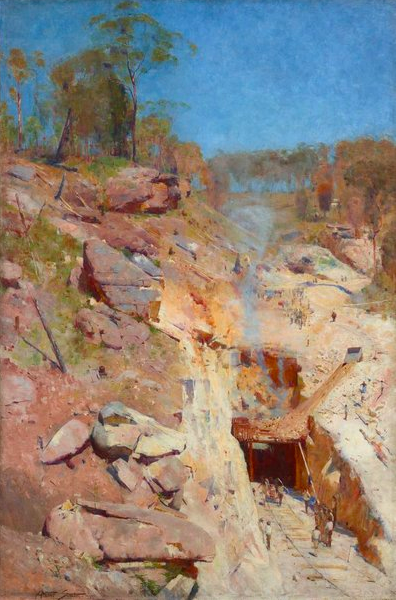
“Fire on Lapstone Tunnel”

How does Anthony street’s “Fire’s on Lapstone Tunnel“ visually reflect ideas explored throughout the unit ‘Australian Literature’ ?

Hanging upon the walls of the National Art Gallery of New South Wales sits the “Fires on Lapstone Tunnel” by Anthony Street. Despite the arrange of Australian pieces that hung beside this painting, I personally feel as if this particular painting by Street has visually cemented my understanding of the themes explored through the unit Australian Literature. I believe in this painting, Street highlights the power of the Australian landscape and the destruction of colonisation on the spiritual, cultural and historical aspects of Australia in which are key ideologies that we have explored throughout the unit. Depicted in the painting is the very first tunnel being created in the Blue Mountains. The art work is split into two sections; to the right hand-side are people small in size building the tunnel while to the left is the natural elements of rock and bush. The left-hand side of the painting is dominate to that of the right-hand side, demonstrating the power of the bush over the colonisers. Moreover, the people in the painting appear inferior to the natural elements and injured due to tumbling rocks. In painting, as the nature appears superior and even dangerous to the colonisers, Street comments on the power as well as catastrophic destruction of the land in which once had historical, cultural and spiritual qualities to Indigenous people, the traditional custodians of the land. The destruction of the land and therefore these qualities were further explored throughout the unit within Lisa Bellear’s poem ‘Urbanised Reebocks’. In her piece, Bellear illuminates the spiritual, historical and cultural corrosion of the traditional way of life for Indigenous Australians due to materialistic obsessions, however, emphasises the importance of the land in healing this sense of destruction. This is evident as Bellear states: “uncloaked feet hit the earth…and it’s ok to cry” (Urbanised Reebocks). It is evident that as the protagonist removes her shoes (and therefore strips herself of materialised creations) she comes in contact with the land in which has a profound effect on her. This contact with the land allows the protagonist to remember the power of nature as opposed to man-made items and reflect upon the destruction of spirituality as well as culture, hence aligning with the Street’s painting. Thus, it can be noted that a key theme taken from the unit Australian Literature is the power of land and the destruction of spiritual, cultural as well historical qualities associated with Australia. It was not until gazing upon Street’s painting that I really connected with these ideologies and pieces of writing explored in class such as Bellear’s poem. The art work provoked me to consider whether or not modern-day Australia appreciates the power of the land and acknowledges the destructions that were forced upon it and the traditional custodians of the land. Perhaps, we are on the right track but perhaps, we also still have a long way to go.

Feature image: “Fire on Lapstone Tunnel” by Anthony Street taken from the National Art Gallery of New South Wales’ website: https://www.artgallery.nsw.gov.au/collection/works/832/

“Down at the Dump”

Chose any one of the Patrick White texts mentioned above and say how you think it illustrates what White was saying in his essay “The Prodigal Son”.

In Patrick White’s essay ‘the Prodigal Son’, White subtly critiques the cyclical and ‘ordinary’ nature of Australian suburbia. However, although acknowledging this sense of ‘ordinary’ that prevailed the streets of Australia, it is also exactly what inspired White to remain here. White took this opportunity of staying in Australia to explore this Australian mundanity and in turn, demonstrate through his writing how ‘poetry’ and  ‘mystery’ can be found beneath the seemingly simple lives of Australians and overrule shallow, materialistic desires. I believe this ideology can be noticed in White’s short story ‘Down at the Dump’ through the juxtaposing characters Myrtle and Meg. In the short story, White expresses Megs deep sadness due to the loss of her Aunt Daise, however on the contrary Myrtle (Megs Mother), does not appear sadden by her sister’s death as she is more so concerned with the way people portray her and her family. This is evident as she states: “Meg?…Did you polish your shoes?”, highlighting Myrtles lack of empathy in the situation as she cares more so of the family’s aesthetic appearance at the funeral than her sisters death. Moreover, this materialistic trait contrasts the ‘poetry’ and ‘mystery’ found within the relationship between Meg and her Aunt, allowing readers to embrace the poetic normality of the relationship and question the materialism of Myrtle. This is evident whilst Meg and Daise are picking flowers as White states: “Meg loved the idea of it, she loved Daise”. Hence, through creating these contrasted characters White allows one to consider the extraordinary emotions that can derive from ordinary relationships and the impact that this can have on one (such as meg). By doing so, he further allows one to question the notion of materialism and think about how materialistic desires can blur one’s sight of the things happening in the world around them.

Feature image: Patrick White taken from google images https://www.google.com/search?biw=1050&bih=585&tbm=isch&sxsrf=ACYBGNQ45Z5vLwsx4J9Fglve55HQ6Bzqdg%3A1571201819864&sa=1&ei=G6OmXYClNIWv9QOxioWgCg&q=patrick+white+&oq=patrick+white+&gs_l=img.3..0l10.2102868.2106316..2106638…1.0..0.699.5305.0j3j0j7j1j3……0….1..gws-wiz-img…..9..35i362i39j0i131j0i67.mW-yXfPhRLs&ved=0ahUKEwjAnt_y_p_lAhWFV30KHTFFAaQQ4dUDCAc&uact=5#imgrc=zT0F9bR7YUkc-M:

A Tribute to Dame Mary Gilmore

Write a short tribute to Dame Mary Gilmore drawing on any one of her poems (in the Pen Anthology 256-259) to show how important her ideas are to Australians.

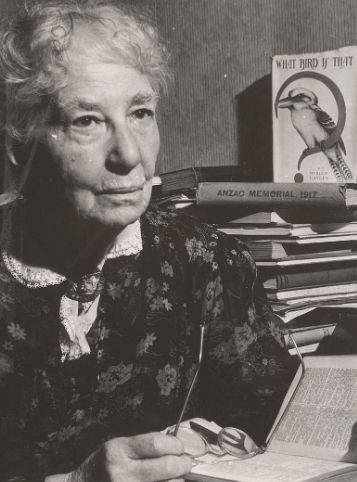
Dame Mary Gilmore had an eloquent way with words. She was able to convey extremely important societal issues of her time in an alluring, concise way and to me this is one of the most impressive aspects of Dame Mary Gilmore’s writing that laments her importance to Australians. This is highlighted throughout her poem ‘Eves Song’ as she was able to resonate ideologies of the poor treatment of women during the 19th century in Australia through her own whimsical way of writing, allowing the poem to still retain meaning to women of today’s society. Dame Mary Gilmore particularly places focus upon the way in which women during this time were subservient to their male-counterpart and were bound to societal expectations of marriage. This can be identified through the repetitive phrase in the poem “I span and eve span”; a biblical allusion which I have interpreted as alluding to the idea that Eve was made purely for Adam’s benefit. Therefore it is necessary and societally expected for women to tend to man. As powerful as the meaning is behind this wonderfully worded statement, it is the way in which Gilmore continues to utilise it throughout her poem in which resonates with me most. The repetition almost reinforces the idea that women always find their way back to this restrictive way of thinking that they are bound to man. It is as if you can see Gilmore’s persistent nature through this very quote; she is passionate and she wants to make it clear to women that they are independent and “that more than man was love and prize”, exemplifying her importance to Australians as this message is still one in which is acknowledged today.

Although we are to commend Dame Mary Gilmore on her writing abilities, her sheer bravery cannot go unsaid. The time in which she wrote did not give women the liberty and free-will to speak their mind, however, Dame Mary Gilmore did exactly that. She is to be acknowledged for this and the message that she so beautifully and strongly articulated through her poem in which is still be appreciated by Australian women today; cementing the importance of Dame Mary Gilmore’s ideologies to Australians.

Feature image: Dame Mary Gilmore taken from google images https://www.google.com/search?biw=1050&bih=585&tbm=isch&sxsrf=ACYBGNTUOLZaKN4MJ2cBuF_Bb4ZoNv_zYw%3A1571201539498&sa=1&ei=A6KmXYKLHsn7rQHKxJzAAg&q=dame+mary+gilmore+&oq=dame+mary+gilmore+&gs_l=img.3..0l3j0i30l2j0i24l5.275203.278391..278639…1.0..0.238.3172.0j14j4……0….1..gws-wiz-img…..8..35i362i39j0i67j0i131j0i8i30.DryM-Yo54Vo&ved=0ahUKEwjCmIft_Z_lAhXJfSsKHUoiBygQ4dUDCAc&uact=5#imgrc=XWPFxz1QsiIW1M:

Blog at WordPress.com.

Up ↑

Design a site like this with WordPress.com
Get started